RegionOuter London South
1.4M
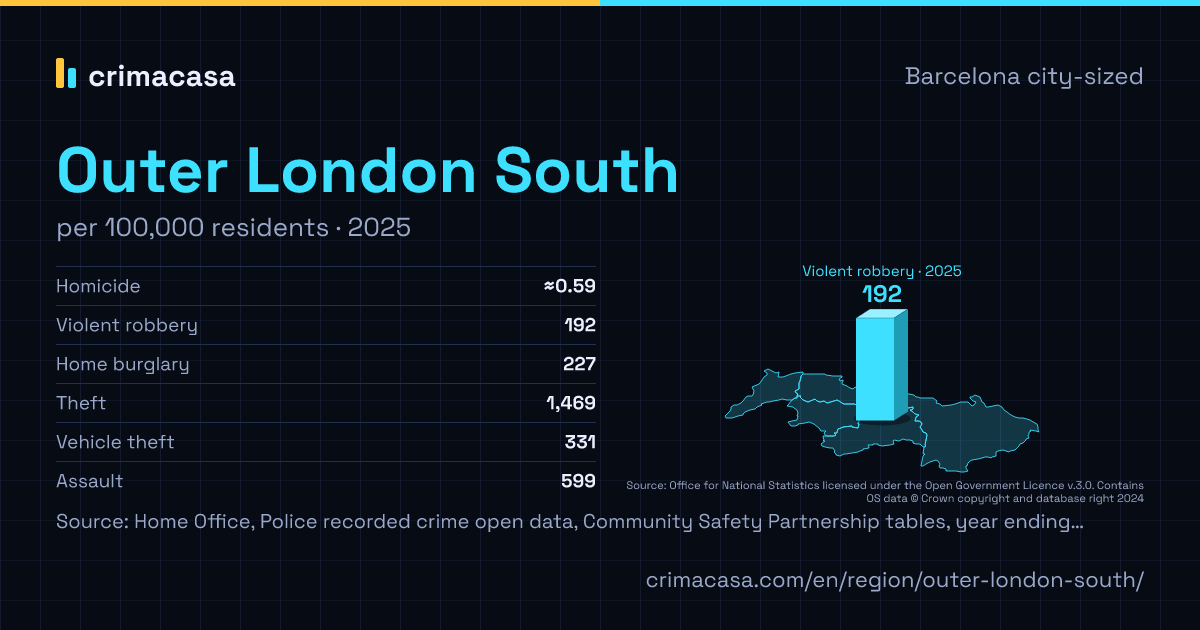
Violent robbery in Outer London South · 2025
192 per 100,000 residents
Violent robbery: Outer London South
The highest rate is in Croydon: 267 per 100,000 residents in 2025.
Compare withNobody
Croydon 267
Bromley 189
Merton 165
Sutton 132
Kingston upon Thames 130
No source publishes arrests by nationality for areas this small, so these columns have no colours under "Split by nationality". Select one to see the figures for the smallest area that publishes them.
Height: recorded crime · Colour: arrests by nationalityDashed outlines: no source publishes nationality figures for areas this small
Data
Violent robbery: Outer London South
| Area | Residents | Rate (per 100,000 residents) |
|---|---|---|
| Croydon | 410,085 | 267 |
| Bromley | 336,048 | 189 |
| Merton | 218,891 | 165 |
| Sutton | 213,972 | 132 |
| Kingston upon Thames | 172,761 | 130 |
Share
Croydon · Violent robbery
No source publishes arrests by nationality for Croydon, so its column on the map has no colours. These figures are for Greater London, the smallest area that publishes them. No split for violent robbery: showing all offences instead.
Largest foreign nationalities · Greater London, all offences, 2024
- Romania3,5353.1% of arrests
- Poland2,2692.0% of arrests
- India2,0901.9% of arrests